
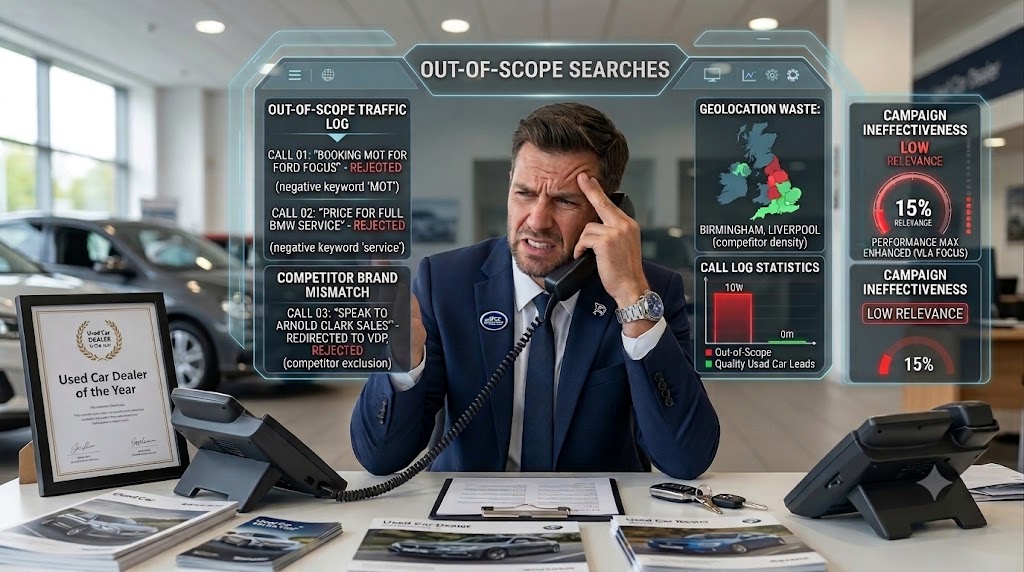
The Shift from Specific Keywords to “Broad Intent”
Traditional Google Ads rely on strict keyword match types, giving you control over what triggers an ad. However, Performance Max (PMax) and Vehicle Listing Ads do away with keywords entirely. Instead, they act as broad “intent engines.” Google’s AI looks at the text on your website, your live vehicle feed data, and user behavior to decide when to show an ad. If a user types in a main dealer name or a generic car query, Google’s AI often assumes they are in the market for a used car or a related service, triggering your ad and leading to an irrelevant phone call.
The “Main Dealer” & Service-Intent Trait
Used car websites are naturally packed with data. Your stock listings contain manufacturer names (e.g., Ford, BMW, Vauxhall), which inadvertently links your dealership to those brands in Google’s eyes.
Furthermore, if a user searches for “Ford servicing” or “BMW MOT near me,” Google’s AI focuses heavily on the brand name and the user’s local proximity. Because independent used car dealers are local and have those brand names all over their site, Google regularly misinterprets the searcher’s intent as a match for your stock, leading to service-related enquiries you don’t want.
Competitor Targeting and Blind Optimisation
PMax is heavily automated and aggressively pursues conversions. If a user searches for a local competitor, Google’s AI treats this as a sign of high “car-buying intent.” It will gladly serve your vehicle ads to that user in an attempt to hijack the lead. While this can sometimes win you a customer, it frequently results in confused buyers clicking the first phone number they see, thinking they are calling the other dealership.
Because PMax buries the exact search terms behind the scenes, these campaigns can continue to bid on competitor names unless strict, manual guardrails are put in place.
The Good News
The vast majority of these terms never get clicked on and so don’t cost you money; they are just very annoying.
Why does this happen to some not all accounts
Dealers that only sell used cars suffer less from this, whereas the dealers who have MOT or servicing centres attached to their business see it more frequently. Even if you are only running Vehicle Listing Ads for the used car stock, Google’s PMax algorithm crawls the entire website. If it finds pages dedicated to “Brakes,” “MOT Booking,” or “Manufacturer Servicing,” the AI automatically establishes a thematic link. It assumes the business wants local service traffic and will weaponise the vehicle feed to capture those broad-intent local buyers.
The Solution
We can significantly clean this traffic up by implementing a comprehensive list of negative keywords directly at the PMax campaign level. Adding comprehensive lists of terms like “servicing,” “MOT,” “repair,” and “parts,” alongside a brand exclusion list for local competitors, will tell the AI exactly where to stop. We also create a “Main Dealer” list which includes all the major OEMs alongside terms such as “Main Dealer” and “Dealership.”
We can also add major competitors as “brand exclusions.” This works well for aggregators and marketplaces like Cinch, Cazoo, and AutoTrader.